

 Become a fan on Facebook
 Follow us on Twitter
 Star YouTube Channel


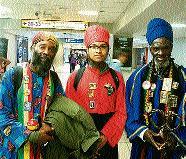
(From left) Kassa, Sabastien and Mitchell. - Contributed
PANAMA
While Rastafari has made inroads well beyond its Jamaican origins, it appears the faith is planting increasingly permanent roots in Central and South America, according to supporters.
"Mi see some other people a embrace Rastafari," said Jamaican Gareth Edwards, who arrived here months ago. "Dem love Rastafari."
In art, music and dress color combinations - of red, green and gold - Rastafari's expanding presence has been noticed, especially in areas like Colon, heavily populated by people of Jamaican descent
"Lots of Rastas there," said Rigo, a Panamanian taxi driver.
"From the little that I see, (Rastafari) is growing," confirmed Priest Kassa, a member of the Jamaica-based Bobo Shanti group.
Kassa, Bobo Priest Harold Mitchell and Prophet Sabastien drew quizzical stares during a stop here last month on their way to spread Rastafarian culture in Uruguay and possibly Brazil and Colombia. Kassa said a tabernacle was opened in Chile and another will be raised in Uruguay and possibly Panama.
"We want it to be a branch of the HQ (in Jamaica), that the people dem can acknowledge our way of worshipping, eating and living in the tradition," he explained. There appears a thirst for knowledge.
"The people, they like our apparel, our way of dressing, and they also like the culture too," said Kassa. "They want to learn more about the prophet, the priest and the king: Honourable Prophet Marcus Garvey; King Emmanuel the high priest; and King Selassie I, the king of kings."
Colombia
Sabastien, 23, discovered Rastafari in his native Colombia, then moved to Jamaica. "When you understand the life," Sabastien explained, "you can live in all bodies, in all flesh, in all kinds of place."
Kassa understands Rastafari's appeal outside Jamaica. "This faith really teach dem fi look inna demself," he said.
Public perception of Rastafari is not perfect. People who wear "false locks" as style, for example, concern the faithful. "In a sense, it disappoints me," said Mitchell. "Sometimes they end up become a Rasta because they get to like (the locks) and see that they get more respect and honour from people," Mitchell said.
The Bobos' mission is to squash unsavoury myths about Rastafari. In Central and South America, it appears the faith is gathering momentum. "It proves to me that the culture is taking over the universe," said Mitchell.

